Once you’ve picked a countertop material, the next question is the edge: the shape cut along the front of the slab. It’s a small detail you see and touch every day, and it changes how the whole kitchen reads. This guide compares the common edge profiles, explains how slab thickness changes your options and covers what to weigh for cleaning, comfort and budget. If you haven’t chosen the material yet, start with our comparison of quartz, quartzite and granite.
The Common Edge Profiles
Fabricators and manufacturers use slightly different names, so bring the industry term to your showroom visit. The descriptions below follow the quartz manufacturer Cambria’s thickness and edge profile guide, which lists each of its edges with the matching industry term.
- Eased: a straight, square line with slightly softened corners. Cambria calls it the simplest and most popular edge profile.
- Straight: a sharp, clean right angle with a very small radius and a bold look.
- Bevel: a diagonal cut along the top of the counter, typically at 45 degrees, for a more defined line than an eased edge. A double bevel cuts the top and bottom.
- Half bullnose (demi bullnose): softly rounded on the top edge.
- Full bullnose: rounded over the entire edge, top and bottom, for a soft curve.
- Ogee: convex and concave curves that form an S shape. It is more elaborate and ornate than the others.
- Mitered: an edge assembled from two pieces so a lighter slab has the look of a much heavier one.
Matching the Edge to Your Kitchen Style
Cambria’s guide gives a simple rule: ornate edges like ogee or half bullnose suit traditional spaces, while eased, bevel or straight edges complement modern designs. The fabricator Freshwater Stone’s edge profile guide says the same about the ogee, pairing it with classic, traditional and Victorian kitchens that use more ornate detailing, and calls the eased edge a fit for streamlined kitchens.
For transitional kitchens, which mix traditional and modern, Houzz’s guide to transitional kitchens advises steering clear of elaborate edge treatments that would look too ornate. Our transitional kitchen design guide covers how the counter, cabinets and hardware work together in that style.
Cleaning, Comfort and Spills
The edge also changes how the counter lives day to day:
- Cleaning: Cambria notes that simpler edges like eased or bullnose are easier to clean, while intricate profiles need more upkeep.
- Rounded corners: Cambria describes bullnose edges as more family-friendly because they reduce sharp corners in high-traffic areas.
- Spills: Freshwater Stone points out a trade-off with the full bullnose. Because it is rounded top and bottom, liquids are more likely to roll off the counter and down the front of your cabinets. A half bullnose is rounded on top and squared on the bottom.
- Leaning: the same guide notes that the Dupont, a stepped profile that keeps a crisp 90-degree top corner, can be uncomfortable if you lean on your counters.
2cm vs. 3cm: How Thickness Changes Your Options
Countertop slabs are sold by thickness in centimeters. Cambria, for example, offers quartz in 1cm, 2cm and 3cm. It describes 1cm as suited to vertical uses like backsplashes and wall cladding, 2cm as a sleek, modern look for countertops without added bulk, and 3cm as a thicker profile for maximum impact on kitchen countertops (Cambria).
Thickness also limits which edges you can get. On Cambria’s chart, for example, the eased edge is listed at 1cm, 2cm and 3cm (plus 4cm), its bevel edges at 3cm (plus 4cm) and its ogee profiles at 3cm or 4cm only. Availability varies by manufacturer and slab, so confirm the edge and thickness together when you choose a slab.
If you want a thick look without a thick slab, that’s what the mitered edge is for. Cambria notes that a mitered edge on a thinner slab creates the illusion of a thicker countertop. If you’re planning a new island as well, our kitchen island design page covers how we plan the island as the room’s focal point.
What the Edge Does to the Budget
Cambria’s guide says elaborate edges like ogee or waterfall can increase costs, while eased edges are a budget-friendly option. Freshwater Stone also calls the eased edge the most economical profile. We don’t quote countertop prices in this post. The price depends on the slab, its thickness, the edge and your layout, and your itemized proposal shows exactly what’s included. For whole-kitchen budgets, see our cost guide.
Edges in Buckhead, Sandy Springs and Brookhaven Kitchens
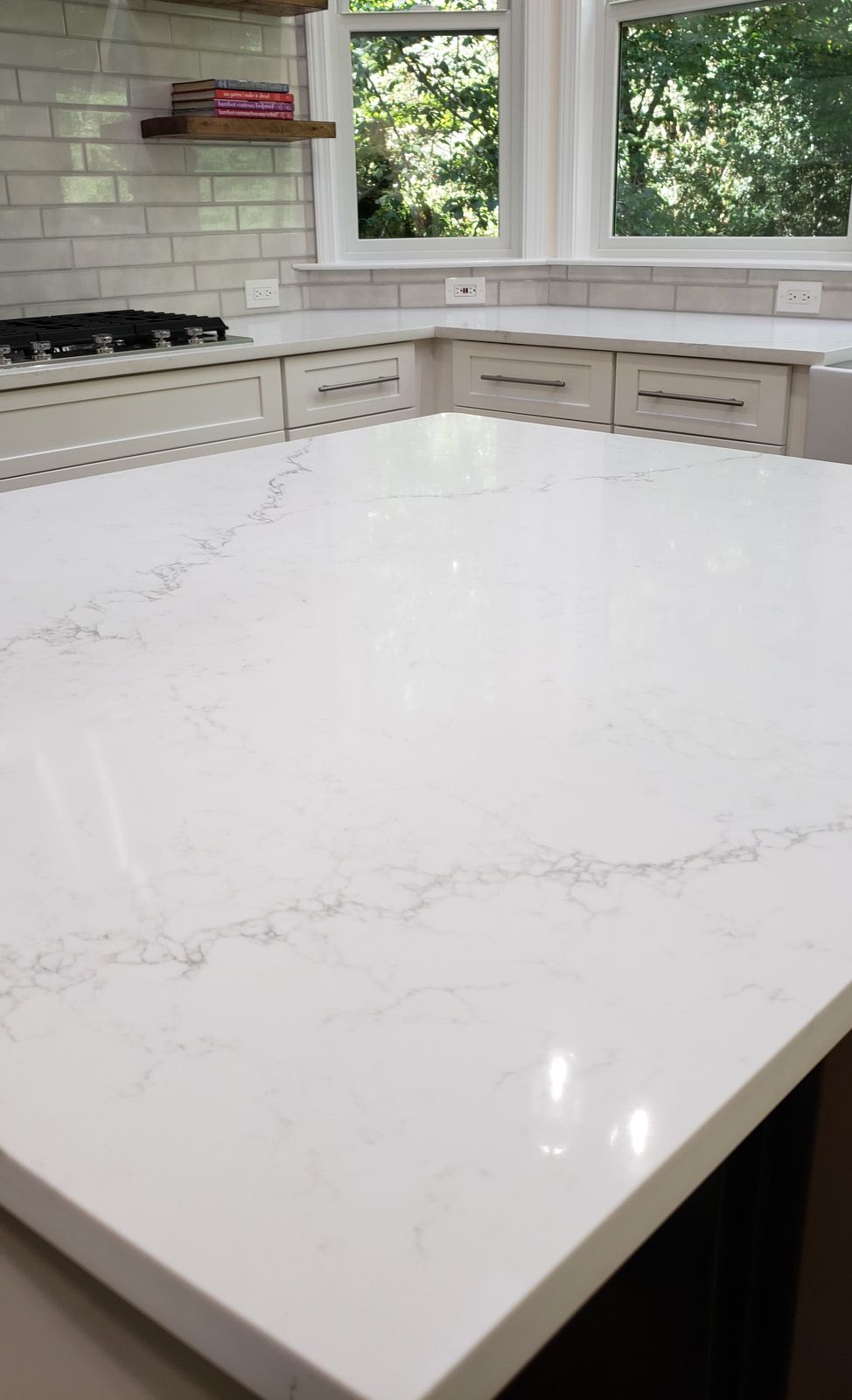
The island in this Buckhead kitchen pairs a light, veined top with a simple eased edge, which keeps the attention on the stone. You can browse more of our local work on our Buckhead kitchen page, our Sandy Springs kitchen page and our Brookhaven kitchen page. If your Brookhaven project also moves plumbing or walls, our permit guide for Brookhaven homeowners explains what the city asks for.
Choosing Your Edge With Us
We install quartz, quartzite and granite, with slabs sourced from local slab yards. At the showroom visit you compare countertop samples alongside door, color and hardware samples, then review the detailed design with 3D color renderings and an itemized proposal. Here is how a project runs from the first meeting to the build:
- Initial Meeting: We meet at your home to talk through your goals and budget and take measurements. At the end of the visit we schedule your showroom appointment.
- Showroom Visit: You compare door, color, countertop and hardware samples, then review the detailed design with 3D color renderings and an itemized proposal.
- Finalizing Design: Our designer and master craftsman do a final design review and final measure at your home.
- Installation: Our remodeling team carries out the build.
Our work is backed by a one-year contractor warranty. See everything included in a remodel on our kitchen remodeling services page, or start with the Buckhead, Sandy Springs or Brookhaven services hub.
Frequently Asked Questions
What is the most common countertop edge?
The eased edge. The quartz manufacturer Cambria calls it the simplest and most popular edge profile: a straight, square line with slightly softened corners.
Which countertop edge is easiest to clean?
Simpler edges. Cambria notes that eased and bullnose edges are easier to clean, while intricate profiles such as ogee need more upkeep.
What is a mitered countertop edge?
An edge assembled from two pieces so a thinner, lighter slab has the look of a much heavier one. The same mitered joint is used where a waterfall countertop turns down the side of an island.
Should I choose a 2cm or 3cm countertop?
It depends on the look and the edge you want. Cambria describes 2cm as a sleek, modern look without added bulk and 3cm as a thicker profile with more impact. Some edges are only offered at certain thicknesses, so choose the edge and thickness together.
Does the edge profile change the countertop price?
It can. Cambria says elaborate edges like ogee or waterfall can increase costs, while eased edges are a budget-friendly option. Your itemized proposal shows the cost for your slab, thickness, edge and layout.
Which countertop materials do you install?
We install quartz, quartzite and granite, with slabs sourced from local slab yards. You compare countertop samples at our showroom visit.
Talk to Us About Your Kitchen
Ready to pick your counters? Call (404) 997-3788 or book a free consultation. The consultation and quote are free.
Kitchen Design Studio & Remodeling of Atlanta
4353 Tilly Mill Road #150
Atlanta, GA 30360
Phone: (404) 997-3788
Office hours: Monday-Thursday 8:30 a.m.-4:30 p.m., Friday 8:30 a.m.-3 p.m., closed Saturday and Sunday.
Licensed in Georgia: RBC0006934