The names quartz, quartzite and granite are easy to confuse. Two are natural stone; one is manufactured. They differ in how they handle heat, whether they need sealing, and how they react to acids like lemon juice. Here’s a plain comparison, with a source for every performance claim.
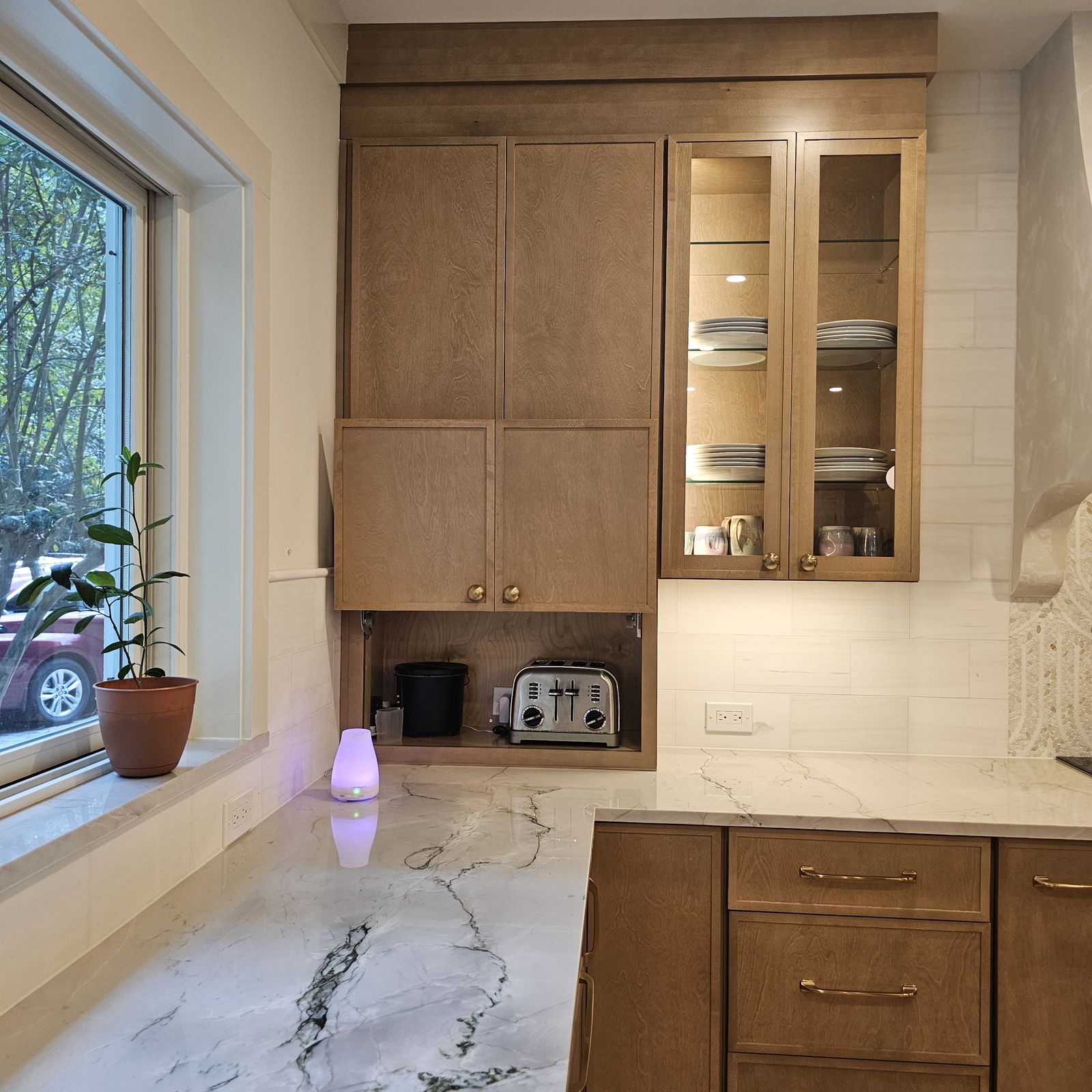
A boldly veined white countertop from one of our kitchens. The stone type isn’t confirmed for this photo.
What Each Material Is
Quartz (engineered stone)
Quartz countertops are manufactured, not quarried. Caesarstone, a major manufacturer, describes its quartz surfaces as made with up to 90% quartz, with the rest pigments and resin (Caesarstone). Because it’s made in a factory, color and pattern are consistent from slab to slab, including marble-look designs with veining.
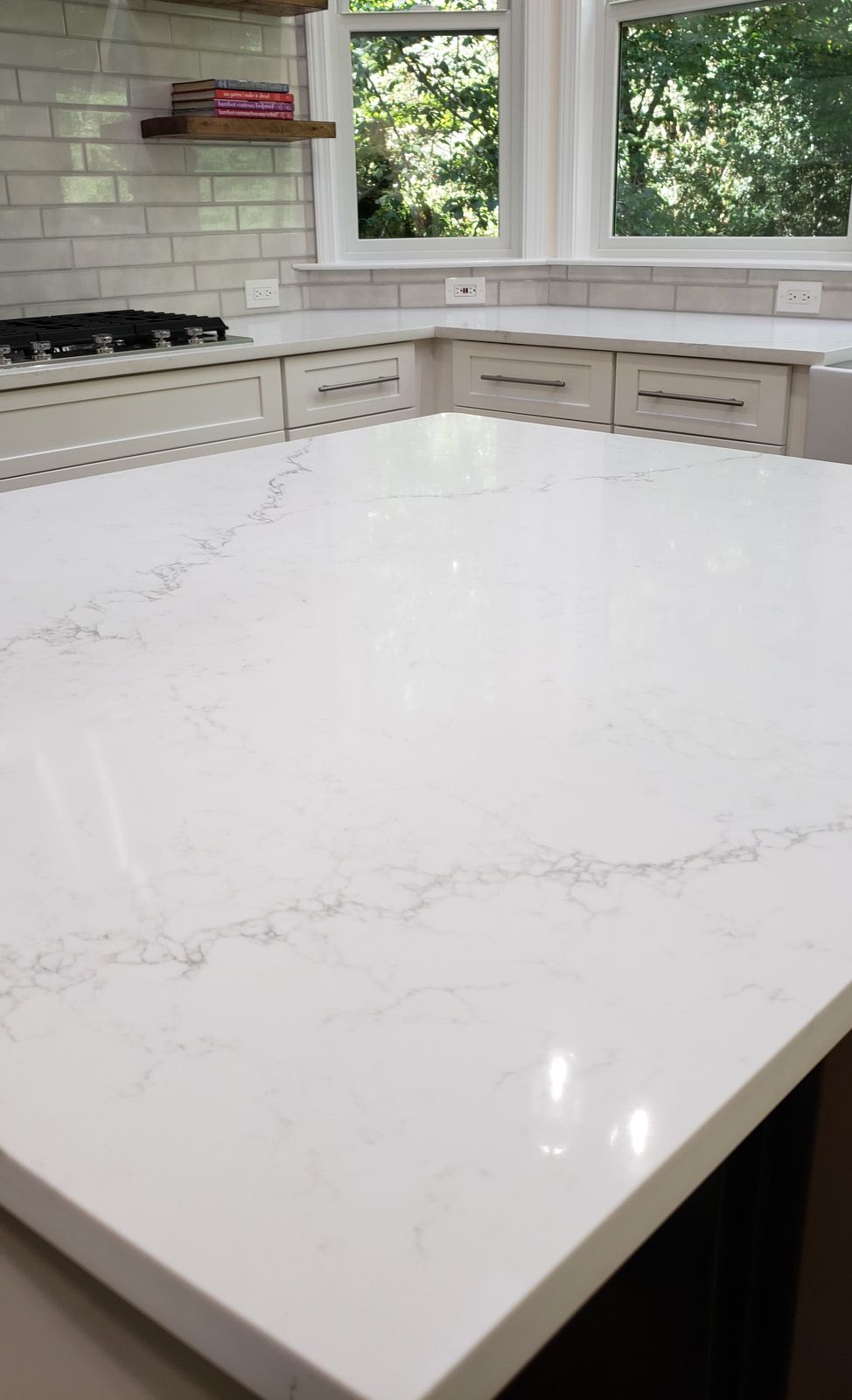
Soft, even veining like this is common in engineered quartz, but the material in this photo isn’t confirmed.
Quartzite (natural stone)
Quartzite is a metamorphic rock that starts as quartz sand, becomes sandstone, and then fuses under heat and pressure into a dense stone made almost entirely of quartz (Use Natural Stone / Natural Stone Institute). It’s usually white or light-colored, sometimes with green, blue or reddish tones, and often has soft, flowing veining that can look like marble.
Granite (natural stone)
Granite is an igneous rock that forms when magma cools slowly underground. It’s made mainly of feldspar and quartz, with smaller amounts of mica and other minerals, which gives it its speckled look (Geology.com).
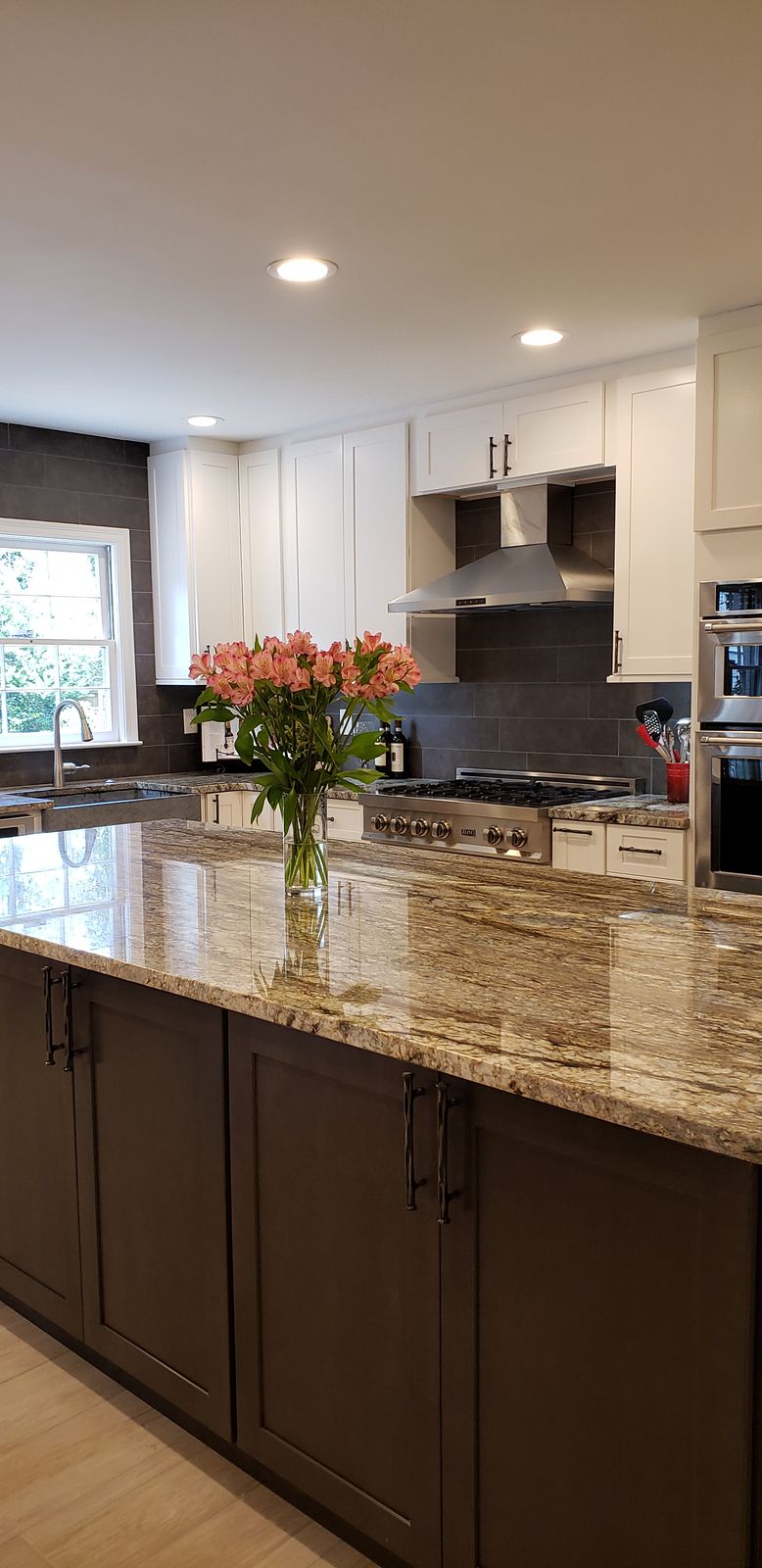
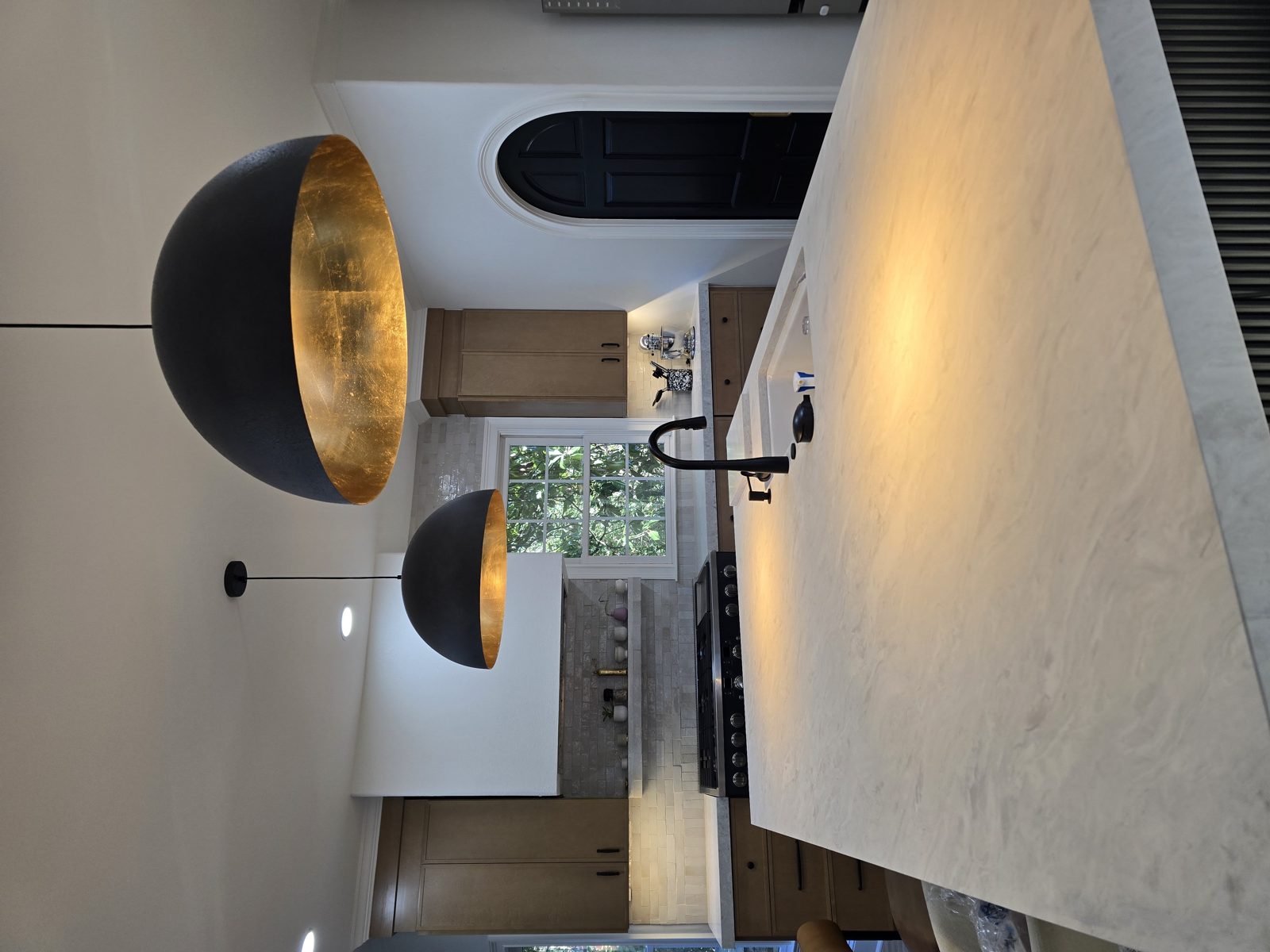
A speckled, granite-look island top. The material isn’t confirmed for this photo.
Side-by-Side Comparison
| Quartz (engineered) | Quartzite (natural) | Granite (natural) | |
|---|---|---|---|
| What it is | Crushed quartz plus resin and pigments | Metamorphic rock, almost all quartz | Igneous rock, mostly feldspar and quartz |
| Hardness | Mostly quartz (Mohs 7); the resin is the weak point for heat | Quartz is 7 on the Mohs scale | Quartz is 7 and orthoclase feldspar is 6 on the Mohs scale |
| Heat | Use a trivet; the manufacturer warns against items above about 300°F | Natural stone; follow your fabricator’s guidance and use a trivet for very hot pans | About 480°F, but localized heat is discouraged |
| Acid etching | Avoid harsh acids and alkalis | Real quartzite doesn’t etch from lemon juice or vinegar | Isn’t etched by everyday kitchen acids |
| Sealing | Not needed | Depends on the slab; more porous quartzites benefit from sealing | Usually sealed; many sealers last for years |
| Look | Consistent; any color or pattern | Light, flowing, marble-like | Speckled or flecked; every slab differs |
| Watch out for | Heat marks (resin burns) | Mislabeling: some “quartzite” is marble | Seams in L- and U-shaped layouts |
Heat: Which Countertop Handles a Hot Pan?
Quartz: Caesarstone advises against placing items hotter than about 300°F directly on its quartz and recommends a hot pad or trivet. It warns that sudden temperature changes can damage the surface (Caesarstone). The resin is what’s vulnerable: a hot pan can leave a brown or yellow “resin burn” (Caesarstone).
Granite: the Natural Stone Institute says granite is typically heat resistant up to about 480°F, but discourages direct localized heat because strong temperature differences inside the stone can start a crack (Natural Stone Institute).
Quartzite: it’s a natural stone made of quartz, so it isn’t vulnerable to resin burns the way engineered quartz is. Ask the fabricator about the specific slab and any resin used to fill natural fissures.
Our advice for all three: use a trivet. It’s a habit that protects any countertop, and it’s the only safe habit with quartz.
Sealing and Stains
Sealing a natural stone doesn’t make it stain-proof. It makes it more stain-resistant, and many stones don’t require it at all, so ask the supplier which sealer to use and how often (Natural Stone Institute).
- Quartz: Caesarstone says its surfaces don’t need regular sealing (Caesarstone).
- Quartzite: porosity varies. Tightly bonded quartzites absorb less, and less compressed ones “will benefit from sealing” (Use Natural Stone).
- Granite: most fabricators seal granite before installation, and many modern sealers last more than 10 years before reapplying (Use Natural Stone). A simple check: put a little hot water on the stone for 10 to 20 minutes, then wipe it off. If the stone darkens, it’s absorbing moisture and is due for resealing (Use Natural Stone).
Etching: The Quartzite and Marble Mix-Up
Etching is the dull spot an acid like lemon juice or vinegar leaves on some stones. Real quartzite doesn’t etch from ordinary kitchen acids; marble and dolomitic marble do. Because the two can look almost identical, some stones sold as “quartzite” turn out to be marble. There’s no such thing as “soft quartzite”; a stone described that way is most likely marble (Use Natural Stone).
Two simple tests on a sample:
- Glass test: real quartzite scratches glass easily. Marble leaves little or no scratch.
- Etch test: leave lemon juice or vinegar on the sample for about 15 minutes, then check for a dull spot.
Both are described by the Natural Stone Institute’s consumer site (Use Natural Stone). Ask for a sample of the actual slab you’re buying.
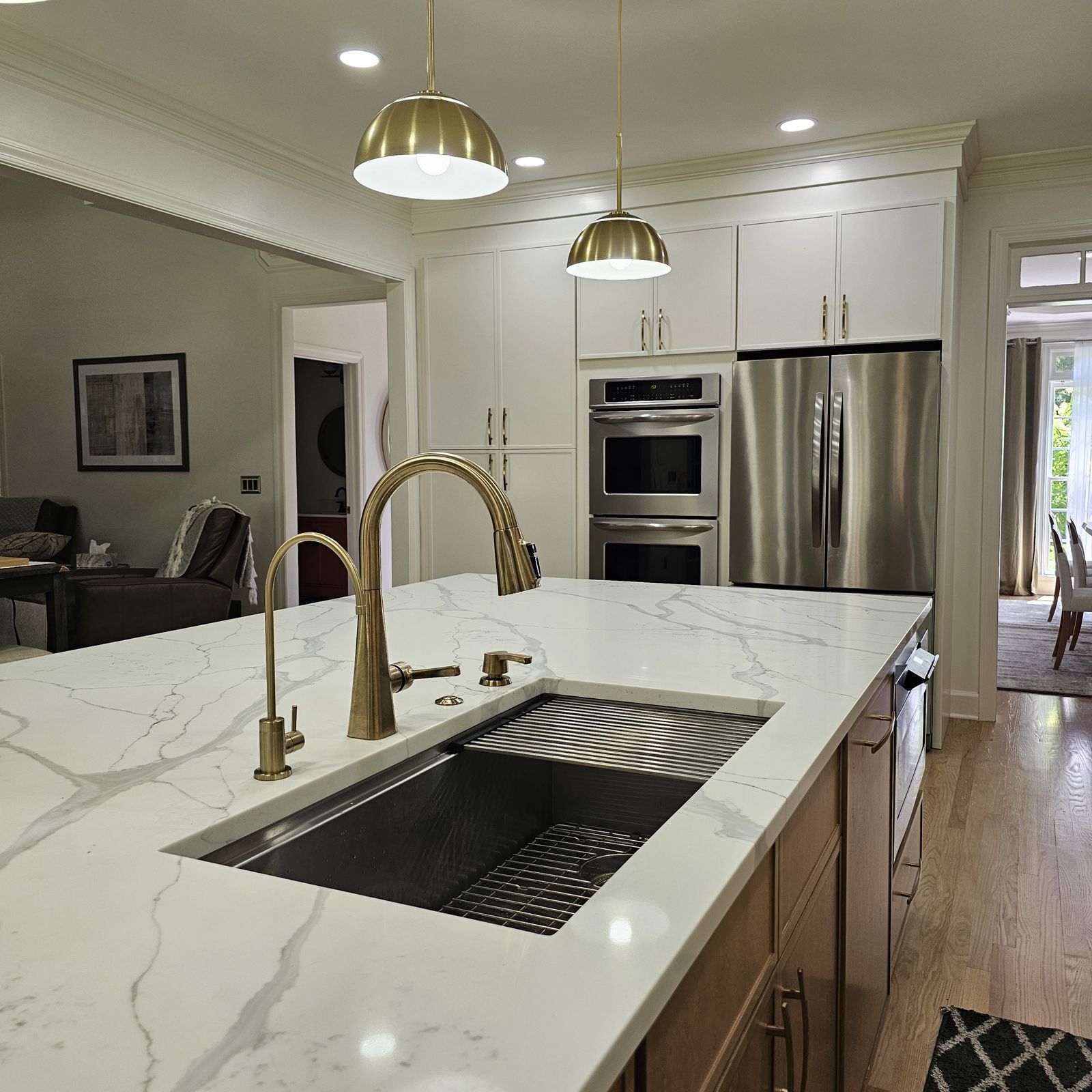
White countertops with gray veining can be quartz, quartzite or marble, which is why testing matters. The material isn’t confirmed for this photo.
Looks, Seams and Layout
- Consistency: quartz is the most predictable, which helps when you want two areas to match exactly. Natural stone varies from slab to slab, so pick your own slabs if you can.
- Seams: natural slab sizes limit how big one piece can be. The Natural Stone Institute’s consumer site says a typical kitchen gets 2 to 3 granite seams, that a typical granite slab is about 9 by 5 feet, and that large islands can often be done without a seam (Use Natural Stone). Plan the seam locations during design.
- Cabinet pairing: a busy granite can compete with two-tone kitchen cabinets; a quieter top lets cabinet color lead.
A Note on Fabrication Dust
Cutting natural and engineered stone releases crystalline silica dust, a serious hazard for fabrication workers. OSHA and NIOSH call for controls such as wet cutting and local exhaust ventilation (OSHA/NIOSH hazard alert).
Other Countertop Materials
We install quartz, quartzite and granite, with slabs sourced from local slab yards. Homeowners also ask about marble, butcher block, laminate, concrete and stainless steel. Marble has classic veining but etches from everyday acids (Use Natural Stone). Ask us about care for the others. Planning an outdoor kitchen? See pairing countertops with your outdoor kitchen backsplash and ideas for a rustic outdoor cooking space.
Which One Should You Choose?
- Choose quartz if you want a consistent look, little maintenance and no sealing, and you’ll use trivets.
- Choose quartzite if you love a light, marble-like look but want a harder, acid-resistant stone. Test the slab first.
- Choose granite if you want natural stone that handles heat well and you like a speckled, one-of-a-kind look.
Price depends on the specific slab, its thickness, the edge profile and the layout. We don’t quote countertop prices here. Your itemized proposal shows exactly what’s included.
Compare Samples at Our Showroom
The best way to decide is side by side. At our showroom, you can compare countertop samples with cabinet doors and hardware, then review your full design in 3D color renderings with an itemized proposal. See our kitchen design process and our kitchen remodeling services.
Quartz vs. Quartzite vs. Granite FAQ
Is quartzite the same as quartz?
No. Quartzite is a natural metamorphic stone made almost entirely of the mineral quartz. Quartz countertops are manufactured from crushed quartz bound with resin.
Which is more heat resistant, quartz or granite?
Granite. The Natural Stone Institute lists granite as heat resistant to about 480°F, while Caesarstone advises against placing items above about 300°F directly on its quartz. Use a trivet on any countertop.
Does quartz need to be sealed?
No. Caesarstone says its quartz surfaces don’t need regular sealing.
Does quartzite etch?
Real quartzite doesn’t etch from everyday kitchen acids like lemon juice or vinegar. If a stone sold as quartzite etches, it’s most likely marble.
How do I know a slab is really quartzite?
Ask for a sample and try the glass test: real quartzite scratches glass easily. An etch test with lemon juice or vinegar also helps tell it apart from marble.
Does granite need to be sealed?
Usually. Most fabricators seal granite before installation. If a little hot water left on the surface for 10 to 20 minutes darkens the stone, it’s time to reseal.
See Countertop Samples in Person
Call (404) 997-3788 to start with a consultation at your home, or visit our showroom at 4353 Tilly Mill Road #150, Atlanta, GA 30360 (Mon–Thu 8:30–4:30, Fri 8:30–3:00 ET). Walk-ins are welcome, and a designer is always there, but appointments are still recommended. Our work is backed by our one-year contractor warranty. We don’t offer financing. You’ll get an itemized proposal before work begins. Homeowners nearby can also see remodeling a kitchen in Brookhaven, kitchen remodeling in Sandy Springs and our Chamblee kitchen projects.